
Day 23 - Driven Oscillations#
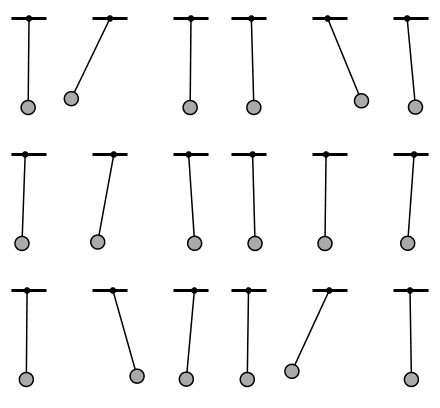
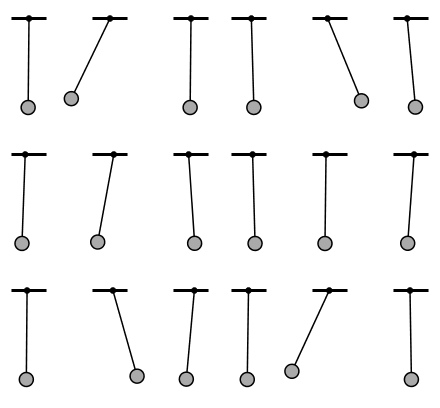
Resonance in a driven pendulum system. \(\longrightarrow\)
Source: Wikipedia
Welcome Richard Hallstein!#
Announcements#
HW 5 given blanket extension to this Friday.
HW 6 still due this Friday, but will be extended if needed.
DC will return Wednesday
Mihir will lead workshop session for HW 6 on Friday
Reminders#
We solved the damped harmonic oscillator equation:
We chose a solution (ansatz) of the form
and computed the roots of the characteristic equation:
We found the roots to be:
Weak Damping#
We found that when \(\beta^2 < \omega_0^2\), the roots are complex:
This means that the solution is oscillatory:
The solution is a damped oscillation with frequency \(\omega_1 = \sqrt{\omega_0^2 - \beta^2}\).
Strong Damping#
When \(\beta^2 > \omega_0^2\), the roots are real:
This means that the solution is not oscillatory: $\(x(t) = C_1 e^{r_1 t} + C_2 e^{r_2 t}\)\( where \)r_1 = -\beta + \sqrt{\beta^2 - \omega_0^2} < 0\( and \)r_2 = -\beta - \sqrt{\beta^2 - \omega_0^2} < 0$.
The solution is the sum of two exponentials with different decay rates.
Critical Damping#
When \(\beta^2 = \omega_0^2\), the roots are real and equal (repeated roots): $\(r = -\beta\)$
This means that the solution is not oscillatory, but also that our ansatz is not sufficient. The correct form of the solution is:
In most cases, we will work with weak damping.
Clicker Question 23-1#
What do we expect the phase space diagram (\(x\) vs \(\dot{x}\)) to look like for a weakly damped harmonic oscillator?
A set of ellipses
A set of spirals
Depends on how weak the damping is
Depends on the total energy
More than one of the above
Clicker Question 23-2#
The driven harmonic oscillator equation is:
with \(w_0^2 = k/m\) and \(2\beta = b/m\). What is the dimension of the driving force \(f(t)\)?
Force (Newtons, N)
Force per unit second (N/s)
Force per unit length (N/m)
Force per unit mass (N/kg)
Clicker Question 24-3#
The driven harmonic oscillator equation is:
This ODE is a ________ differential equation.
linear
nonlinear
first-order
second-order
more than one of the above
Example: Sinusoidal Driving Force#
Let \(f(t) = f_0 \cos(\omega t)\), so that the driven harmonic oscillator equation is:
Note: \(\omega \neq \omega_0\)
Note that if the driving follows a sine wave, then we have:
Interesting, \(e^{i \omega t} = \cos(\omega t) + i \sin(\omega t)\), let try to work with \(z(t) = x(t) + i y(t).\)
Clicker Question 24-4#
We found that the square amplitude of the driven harmonic oscillator is:
When is the amplitude of the driven oscillator maximized?
When the driving frequency (\(\omega\)) is far from the natural frequency (\(\omega_0\))
When the driving frequency (\(\omega\)) is close to the natural frequency (\(\omega_0\))
When the damping (\(2\beta\)) is weak
When the damping (\(2\beta\)) is strong
Some combination of the above