
Homework 7 (Due 27 Mar)#
Grading Breakdown
Individual Exercise (20 points) - Ex 0
Pencil and Paper Exercises (40 points) - Ex 1-3
Numerical Exercise (40 points) - Ex 4
Practicalities about homeworks
Individual exercises. You must work alone on these exercises and hand in your own answers. This should be submitted on D2L only (Homework 6 Exercise 0). Individual exercises are marked with “Individual Exercise” in the title and are counted separately from the rest of the homework.
For pencil and paper, or numerical exercises, you may work in groups of up to 3. If you work as a pair/group you may hand in one answer only if you wish. Remember to write your name(s)! These exercises are marked with “Pencil and Paper Exercises” or “Numerical Exercise” in the title, and are counted together for the homework grade.
Beyond the group you work on homework with, you may collaborate with others to discuss concepts and approaches, but you must write up your own answers (alone or as a group of 3).
Homeworks are available approximately ten days before the deadline. You should anticipate this work.
How do I(we) hand in? You can hand in the paper and pencil exercises as a single scanned PDF document. For this homework this applies to exercises 1-5. Your jupyter notebook file should be converted to a PDF file, attached to the same PDF file as for the pencil and paper exercises. All files should be uploaded to Gradescope.
Make sure your work is legible. If we cannot read it, we cannot grade it.
import numpy as np
from math import *
import matplotlib.pyplot as plt
import pandas as pd
%matplotlib inline
plt.style.use('seaborn-v0_8-colorblind')
Individual Exercise (Submit on D2L only)#
Exercise 0 (20pt): Whose Land, Whose Sky? Sovereignty, Place, and the Politics of Big Science#
This exercise is longer than other Exercise 0s, but it is designed to synthesize your learning across numerous Exercise 0s. The pencil and paper exercises are shorter this week to allow you time to engage with the readings and questions in this one. Please take this seriously and give yourself the time to read and reflect on the materials.
The exercises in this course have asked you to examine physics from multiple angles: whose labor built it, whose stories are told, who profits, and whose data is extracted. In this extended exercise, we ask one more foundational question: where does science happen and who decides?
Modern “Big Science” like particle accelerators, gravitational wave detectors, radio telescope arrays requires specific physical places. These places are not neutral. They sit on land with histories, legal claims, and communities who have lived with and on them for generations. The question of who controls these places, and on what terms, is inseparable from the science itself.
The controversy over the Thirty Meter Telescope (TMT) on Maunakea in Hawaiʻi is one of the most significant live examples of this tension in contemporary science. In 2019, the state of Hawaiʻi attempted to begin construction of the TMT on the summit of Maunakea — a dormant volcano, the highest peak in the Pacific, and a site sacred to Native Hawaiian communities who hold it central to their cosmology. A sustained occupation of the access road blocked construction for months. The movement attracted supporters from around the world, including physicists, astronomers, and Indigenous scholars, and forced open deep questions about the relationship between scientific institutions and the peoples whose lands they occupy.
 Maunakea summit, site of multiple existing observatories and the proposed TMT. Source: Wikimedia Commons, Public Domain
The spelling Maunakea (one word) reflects the Hawaiian language and is preferred by many Native Hawaiians. Mauna Kea (two words) is the anglicized form. In this exercise, we use both, as different sources use different spellings. This is itself a small example of how language carries political and cultural weight.
Why are we reading this?
The Maunakea controversy is often framed in mainstream media as a conflict between science and religion. That framing is itself worth interrogating. Native Hawaiians have their own systems of knowledge about the sky and the land, systems built over centuries and tied to navigation, agriculture, and cultural identity. The question is not whether astronomical science is valid. The question is whether one knowledge system has the right to displace another, on what grounds, and who gets to decide.
And while we ask “whose land?” we must also ask “whose sky?”
The night sky itself is increasingly being claimed by private capital. Elon Musk’s SpaceX Starlink constellation has launched thousands of satellites into low Earth orbit and is now the world’s largest satellite network, with nearly 10,000 satellites in orbit and ongoing plans to deploy even more. Recent reporting notes that SpaceX aims to add at least 1,200 upgraded satellites in the near term and to launch millions in the future to keep scaling to achieve truly global coverage, while generating billions of dollars in annual revenue. These satellites leave bright streaks across astronomical images, disrupting ground-based astronomy worldwide and prompting concerns about contamination of astronomical data. The International Astronomical Union has raised alarms about how satellite mega-constellations like Starlink and others will interfere with both ground-based and space-based observations and has established a dedicated Centre for the Protection of the Dark and Quiet Sky from Satellite Constellation Interference.
Indigenous communities, astronomers, and dark-sky advocates have pointed out that no single corporation sought or received permission from humanity to fundamentally alter the appearance of the night sky — a commons that has belonged to all peoples and cultures for millennia. The question of who controls the sky above us is as urgent as the question of who controls the land beneath the telescopes.
You are not expected to resolve this controversy. You are expected to understand its contours, engage with its complexity, and begin to think about how you would navigate these tensions as a scientist.
For this exercise, read/skim the following sources:
Background on the controversy: Thirty Meter Telescope on Wikipedia — focus particularly on the sections covering Indigenous opposition, the 2019 protests, the legal proceedings, and the current status of the project. This will give you a grounding in the basic facts before you engage the more analytical sources.
A pro‑science perspective: “Thirty Meter Telescope will be a most powerful eye on the sky” (INTERNET ARCHIVE: University of California news article, 2021). This piece explains in accessible language what the TMT is, why Maunakea is scientifically important, and what kinds of discoveries (from exoplanets to the early universe) astronomers hope to make with it. Read the article with an eye to how it frames the benefits of the telescope, who is imagined as the main beneficiary of those benefits, and how (or whether) it addresses social or ethical concerns about building on Maunakea.
A pro‑Indigenous perspective: “An Astronomical Controversy: The Thirty Meter Telescope and the Need for Indigenous Voices in Science” (INTERNET ARCHIVE: UW–Madison CASP blog, 2020) or a similar public‑facing piece by Kānaka Maoli scholars and activists. This reading introduces how many Native Hawaiians understand Maunakea through concepts like kuleana (responsibility), ʻāina (land), and sovereignty, and it frames the TMT conflict as a question of governance rather than mere “feelings versus science.” As you read, pay attention to how the author defines legitimate authority over the mountain, what counts as harm, and what a just scientific practice would need to look like from this perspective.
Short on time? At minimum, read the Wikipedia article thoroughly and at least one of the other two sources. Full engagement with all three will strengthen your responses.
Now answer the following questions:
0a (4pt) In ~150 words, summarize the Maunakea/TMT controversy. What is the Thirty Meter Telescope and what new kinds of astronomical observations would it enable? Who opposes the project, and on what grounds? Briefly describe the major events of the 2019 blockade/occupation of the access road. What legal or political decisions have been made about the project since then, and what is its current status? Aim for clear, neutral description — establish the factual record before you evaluate it.
0b (4pt) In ~150 words, describe the specific claims made by Native Hawaiian communities regarding Maunakea. Be precise: what is the cultural and spiritual significance of this mountain for Kānaka Maoli? What concepts (such as kuleana or ʻāina) shape how they understand their relationship to the land? What legal and governance claims do they make about who has authority over Maunakea? Avoid treating these as “beliefs” opposed to science; focus on what forms of knowledge and authority are being asserted.
0c (4pt) In ~150 words, compare how the pro‑science TMT reading and the pro‑Indigenous reading frame the controversy. According to the pro‑science piece, what are the main scientific benefits of the TMT, and who is imagined as benefiting? According to the pro‑Indigenous piece, what harms, risks, or injustices are foregrounded, and for whom? What does each text say — or fail to say — about sovereignty, land, and governance? Explain how reading them together complicates a simple “science versus tradition” framing.
0d (4pt) In ~150 words, connect the Maunakea controversy to at least two earlier exercises in this course. You might consider: How does the question of where science happens relate to questions about whose labor and which communities make it possible? How does the concentration of funding and power in Big Science resemble issues you have discussed previously? How do the debates over access, ownership, and benefit from TMT’s data relate to any Open Science principles you have studied? Name specific earlier topics, texts, or cases and describe the connections clearly.
0e (4pt) In ~150 words, imagine you have been invited to join the TMT project’s science team. You believe the telescope could produce genuinely important scientific results, but you also take seriously the Indigenous sovereignty and governance issues raised in the readings. What would you do, and why? What questions would you want answered before deciding whether to join? What concrete practices — in how you do research, engage with communities, and communicate about the project — would reflect the values you have developed in this course? There is no single correct answer; focus on your reasoning.
Pencil and Paper Exercises (Submit on Gradescope only)#
Exercise 1 (10pt) Where does the energy go?#
The damped harmonic oscillator is described by the equation of motion is:
where \(m\) is the mass, \(b\) is the damping coefficient, and \(k\) is the spring constant.
The damping term (\(F_{damp} = - b\dot{x}\)) models the dissipative forces acting on the oscillator. The total energy for the oscillator is given by the sum of the kinetic and potential energies,
1a (3pt). What is the energy per unit time dissipated by the damping force?
1b (4pt). Take the time derivative of the total energy and show that it is equal (in magnitude) to the energy dissipated by the damping force.
1c (3pt). What is the sign relationship between the energy dissipated by the damping force and the time derivative of the total energy?
Exercise 2 (10pt), Unpacking the critically damped solution#
The solution for critical damping (\(\beta = \omega_0\)) is given by,
where \(A\) and \(B\) are constants. Notice the second solution \(x_2(t) = Bte^{-\omega_0t}\) has an additional linear term \(t\). We glossed over this solution in class, but it is important to understand why this term is present because it tells us about solving differential equations with pathologically difficult-to-see solutions.
Start with the under damped solutions,
where we have used the notation \(\omega_1 = \sqrt{\omega_0^2 - \beta^2}\).
2a (3pt). Show that you can recover the first solution \(x_1(t)\) by taking the limit of \(\beta \rightarrow \omega_0\) of \(y_1(t)\).
2b (3pt). Show that you cannot recover the second solution \(x_2(t)\) by taking the limit of \(\beta \rightarrow \omega_0\) of \(y_2(t)\) directly. What do you get?
2c (4pt). If \(\beta \neq \omega_0\), you can divide \(y_2(t)\) by \(\omega_1\). Now show that in the limit \(\beta \rightarrow \omega_0\) of \(y_2(t)/\omega_1\), we recover the form of \(x_2(t)\).
Exercise 3 (20pt), Exploring the damped harmonic oscillator#
You can choose to solve this exercise using analytical, or graphical methods. Should you decide to use numerical methods, you should make sure to use a method that conserves energy. However, this exercise does not need to be solved numerically as closed form solutions exist.
The solution to the simple harmonic oscillator is given by,
where \(A_{sho}\) and \(B_{sho}\) are determined by the initial conditions. The solution to the underdamped harmonic oscillator is given by,
where \(A\) and \(B\) are also determined by the initial conditions.
Scenario 1#
An undamped oscillator has a period \(T_0 = 1.000\mathrm{s}\), but then the damping is turned on. We observe the period increases by 0.001 seconds.
3a (3pt). What is the damping coefficient \(\beta\)?
3b (3pt). By how much does the amplitude of the oscillation decrease after 10 periods?
3c (3pt). What would be able to notice more easily, the change in period or the change in amplitude?
Scenario 2#
An undamped oscillator has a period \(T_0 = 1.000\mathrm{s}\). With weak damping, the amplitude drops by 50% in one period \(T_1\). Recall the period of the damped oscillator is given by \(T_1 = 2\pi/\omega_1\).
3d (3pt). What is the damping coefficient \(\beta\)?
3e (3pt). What is the period of the damped oscillator?
3f (3pt). By how much does the amplitude of the oscillation decrease after 10 periods?
4g (2pt). What would be able to notice more easily, the change in period or the change in amplitude?
Exercise 4 (40pt), The Damped Driven Oscillator#
The damped driven oscillator is described by the equation of motion,
where \(F_0\) is the amplitude of the driving force and \(\omega\) is the frequency of the driving force. We reduced this equation by dividing by \(m\) to get the equation of motion in terms of the damping coefficient \(\beta = b/2m\) and the natural frequency \(\omega_0 = \sqrt{k/m}\). In the equation below, \(f(t) = F_0/m\).
We solve this equation for sinusoidal driving forces, \(f(t) = f_0\cos(\omega t)\) and demonstrated the resonance effect. In this exercise, we will numerically solve the equation of motion. This will allow us to explore the behavior of the damped driven oscillator for different periodic driving forces, not just sinusoidal ones.
4a (10pt). Modify the code (or write your own) include a driving force \(f(t) = f_0\cos(\omega t)\).
To start, choose \(f_0\)=1, \(\omega_0\)=10 and \(\beta\)=0.1.
Check that your code produces a steady state solution for the driven harmonic oscillator. Roughly, what is the steady state amplitude, \(A(t \rightarrow \infty)\), of the driven oscillator?
4b (10pt). For different choices of the driving frequency \(\omega\), observe the behavior of the driven oscillator. Describe the behavior of the driven oscillator for \(\omega \ll \omega_0\), \(\omega \approx \omega_0\), and \(\omega \gg \omega_0\).
4c (20 pt). Sweep the driving frequency \(\omega\) at a fixed amplitude and store the amplitude of the steady-state solution. Plot the amplitude of the steady-state solution as a function of the driving frequency \(\omega\). Describe the behavior of the amplitude as a function of the driving frequency.
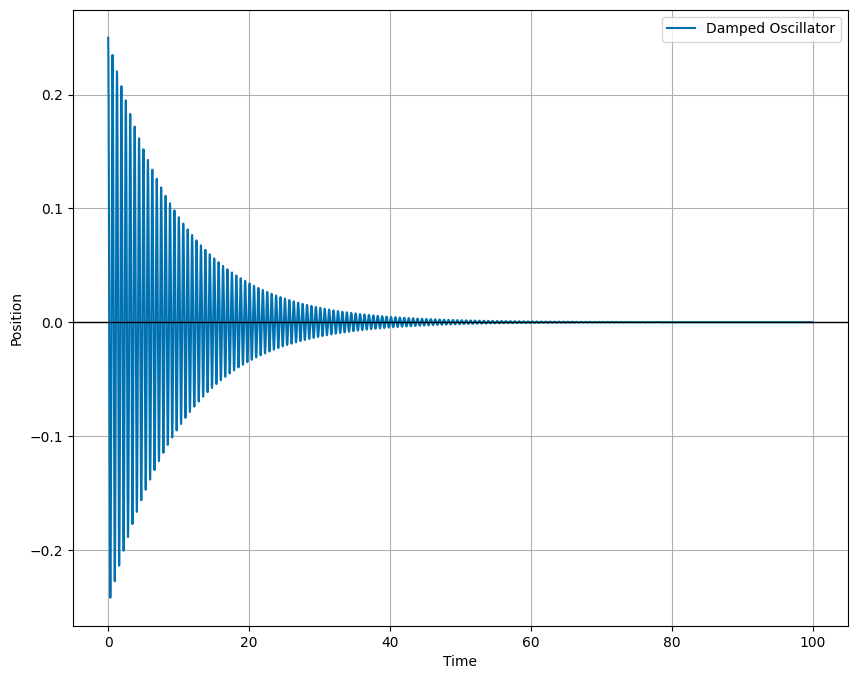
We have written a numerical solver for the damped undriven oscillator; it’s similar to the prior codes we’ve used. Your task is to modify the code to include a driving force. We have used the second order Runge-Kutta method to solve the equation of motion. You can use the code as a starting point for the damped driven oscillator. Notice we also call the code in the next cell.
def ddho(y, t, omega_0, beta):
    """
    Function to compute derivatives based on the damped driven oscillator model.
    Notice the driving force is included but zero.
    """
    x, v = y
    dxdt = v
    dvdt = -2 * beta * v - omega_0**2 * x
    return np.array([dxdt, dvdt])


def rk2_step(y, t, dt, omega_0, beta, F0=1.0, omega=10, phase=0.0):
    """
    Performs a single step of the Runge-Kutta 2nd order (midpoint) method.

    Parameters:
    - y: current state [position, velocity].
    - t: current time.
    - dt: time step size.
    - omega_0: natural frequency of the oscillator.
    - beta: damping coefficient.
    - F0: amplitude of the driving force.
    - omega: frequency of the driving force.
    - phase: phase of the driving force.

    Returns:
    - y_next: state at time step dt [position, velocity].
    """
    k1 = ddho(y, t, omega_0, beta)
    k2 = ddho(y + 0.5 * k1 * dt, t + 0.5 * dt, omega_0, beta)
    y_next = y + k2 * dt

    return y_next
# Simulation parameters
T = 100.0  # total time
dt = 0.01  # time step
omega_0 = 10  # natural frequency
beta = 0.1  # damping coefficient

steps = int(T / dt)
t = np.linspace(0, T, steps)
y = np.zeros((steps, 2))  # Array to hold position and velocity

## Initial conditions
y[0] = [0.25, 0.0]  # x=1, v=0

for i in range(steps - 1):
    y[i + 1] = rk2_step(y[i], t[i], dt, omega_0, beta)

oscillator = pd.DataFrame(y, columns=["Position", "Velocity"])
oscillator["Time"] = t

# Plotting the results
plt.figure(figsize=(10, 8))
plt.plot(oscillator["Time"], oscillator["Position"], label="Damped Oscillator")
plt.axhline(0, color="black", linewidth=1)
plt.xlabel("Time")
plt.ylabel("Position")
plt.grid(True)
plt.legend()
<matplotlib.legend.Legend at 0x116655e80>
Extra Credit — Integrating Research#
Earning and Submitting Your Summary
Earn up to 5 extra credit points per homework by engaging with MSU research activities. These points can boost your grade above 100% or help offset missed exercises.
Send via email to Danny caball14@msu.edu
Earn up to 5 extra credit points per homework by engaging with MSU research activities. These points can boost your grade above 100% or help offset missed exercises.
To receive full credit:
Attend an MSU research talk (see approved clubs and seminars below).
Write a summary of the talk (at least 150 words).
Submit your summary with your homework (email to caball14@msu.edu).
Approved talks include:
Society for Physics Students (SPS): Meets Monday nights (alternates with Astronomy Club)
Astronomy Club: Meets Monday nights (alternates with SPS)
Any physics and astronomy seminar of interest
Any MSU research seminar/workshop relevant to physics (get approval if unsure)
Any other physics-related event approved in advance
If you have questions, please contact Danny.
Note: You can earn 5% extra credit on each homework by attending a seminar, workshop, or other physics-related event and submitting a short reflection (about 150 words) on your experience.