
Exercise 0#
HW 1: Physics as Work: Whose Labor Builds “Foundations”?#
You have just begun a course that often presents physics as a set of timeless laws discovered by a small number of brilliant individuals. In fact, much of the collective history of physics has been framed this way, often omitting the contributions of many people whose labor made those discoveries possible. It’s an unfortunate but common narrative that can shape how we think about who does physics and how it is done. All scientific work, including physics, happens within workplaces, institutions, and economies. Physics is no more apolitical than any other human endeavor. We define politics broadly here to include questions of power, labor, resources, and social context.
To be clear, politics are not distractions from “real” physics; they are part of how physics is made and understood.
Physics is the Work of Many
 Image credit: Wikimedia Commons, Public Domain
The photo above shows part of the team that operates the Vera C. Rubin Observatory in Chile. The observatory is named after Vera Rubin, whose pioneering work on galaxy rotation curves provided some of the first evidence for dark matter. But as you can see, many people are involved in making the observatory work, from scientists to engineers to technicians to support staff. Their collective labor is essential for the observatory to function and for the scientific discoveries it will enable.
0a: In ~150 words, reflect on an example of “foundational work” in physics you already knew before this course (e.g., Newton, Galileo, Kepler, Maxwell). Describe where you first learned the story and how it framed the scientist — as lone genius, heroic figure, careful observer, etc. then discuss how that framing shaped your impressions of physics as a field of study.
0b: In ~150 words, identify the forms of hidden, collective, or material labor that such stories often omit (instrument makers, calculators, students, artisans, workers who built observatories, printers who circulated texts, etc.). Connect this to your first impressions of the field as you enter PHY321. How does recognizing this labor change your understanding of how physics is done?
0c: In ~150 words, propose a way physics education could better represent the collective and material labor that makes scientific discovery possible. What would that change about how you imagine yourself participating in physics? How might it change how others see the field?
HW2: How do we talk about scientific efforts?#
Learning about how science has been done and the stories that we tell ourselves about it are important.
The stories we tell ourselves
You are likely familiar with the statement “Standing on the Shoulders of Giants” – a quote that has been attributed to a number of different people including Newton and Pascal. It’s so famous, that Stephen Hawking has written a book with the title, Google Scholar uses the phrase as its tagline, and the band Oasis even has an album with the name.
However, have you ever considered that phrase critically?
Have you considered how that statement frames science as the accomplishments of single individuals or brilliant thinkers? Or how that “Shoulders of Giants” framing erases the many contributions of everyday people and even learned contributors to science?
This framing suggests a specific way that science came about: through the heroic efforts of singular individuals. This framing doesn’t acknowledge the contributions of many people including those who could not/cannot read or write, those who were not part of privileged classes, or dominant cultures, and even scientists who were fortunate to become known in their own right.
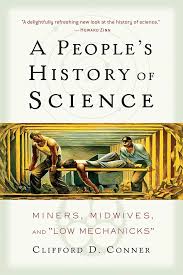
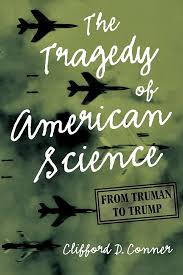
For this exercise, we ask that you read this interview with Dr. Clifford D. Conner, author of A People’s History of Science and The Tragedy of American Science: From Truman to Trump, and then respond to the questions below.
📂 Source for interview: https://selections.rockefeller.edu/wp-content/uploads/2012/07/ns-03-2006.pdf
Why are we reading this?
This interview and its contents might challenge your vision of science and the world. That is ok, you don’t have to agree with Dr. Conner’s views, but it is important for you to learn about these other perspectives.
It is also ok if the history raised or the words used are unfamiliar to you; learning this history and the unfamiliar words is part of learning about science.
And if you have questions, just ask.
0a: In ~150 words, summarize the interview, what you learned from it, and what you have more questions about.
0b: In ~150 words, how does Conner frame the development of science? What evidence does Conner use to do this?
0c: In ~150 words, what do you think about Conner’s framing of the development of science? How does it align or conflict with your current (or prior) understanding of the development of science?
HW3: Physics and Capital#

Fig. 42 Artist rendition of the first nuclear reactor. Erected in 1942 at the University of Chicago’s Stagg Field. Source: Wikimedia Commons#
There’s a substantive argument to be made that physics as an enterprise has driven capital investment and the development of technologies that we enjoy. There’s also an argument that can be made that the defense and weapons industry invested heavily in physics research, especially during the Cold War, which lead to the development consumer products as corporate actors looked for places to make additional profits. There’s still another argument that the exploitation of people and resources in nations and lands that are less developed than the US and Western Europe provided the necessary materials and capital to develop Big Science.
Certainly the story of physics and the development of our politics and economy is more complex than these isolated arguments. But, the stories that are platformed matter to physics, to science, and to our society.
Some in physics like Michio Kaku have adopted ways of thinking and writing that speak about the future of physics, technology, and the world. Their prognostications are often more fantasy than reality. Seriously, read any of their books. Increasingly, with the rise of billionaire technologist who explore even more fanciful futures that are inaccessible to most, we should take a moment to read and deconstruct how physics is being used to make these arguments seem plausible (they are not).
Read this 2022 interview from the World Economic Forum with Michio Kaku on how Physics could create the “Perfect Capitalism”: https://www.weforum.org/stories/2022/01/michio-kaku-says-physics-will-create-a-perfect-capitalism/
Why are we reading this?
This interview and its contents are important for us to understand. Many members of society including policy-makers hear scientists like Kaku and assume they are speaking with authority and clarity - like they do more frequently in research physics. However, we must distinguish between established science and ideas for the future.
Moreover, we need to understand the relationship between physics, politics, and the economy, especially when certain voices are elevated and heard above others. The arc of scientific research has often been bent towards the interests of the powerful and the vocal. For example, take the recent gutting of federal science and science education by billionaire technologist Elon Musk and the DOGE commission, which has sent American science back at least a decade.
You don’t have to disagree or agree with the views presented in the interview; it is important for you to learn about how others speak about our discipline, so you can decide how you will do so.
And if you have questions, just ask.
Now answer the follow questions:
0a: In ~150 words, summarize the interview with Kaku, what you learned from it, and what you have more questions about.
0b: In ~150 words, react to this section of the interview. Use your own understanding of wealth and where you understanding of it in comes from. In doing so, critique Kaku’s statement. Note that Kaku’s definition is not so much different from your own in that his simply comes from his own experience and views about the world; not from the scholarly study of economics and history.
To understand economics, you must understand where wealth comes from. If you talk to an economist, the economist might say, “Wealth comes from printing money.” A politician might say, “Wealth comes from taxes.” I think they’re all wrong – the wealth of society comes from physics.
Physicists like Kaku often speak in the absolute, especially in mass media. They also frequently speak about things that are far more complex and nuanced than their understanding of it is. Physics is model-driven and so these physicists often apply reductionist arguments to complex ideas.
For example, Kaku states, “[t]he Chinese system works because they’ve mastered one art: copying.”
This is both a sweeping and a false statement that is easily refuted by observing the substantial investments in green energy technologies and developments of high-speed train systems throughout China. China leads the world in both of these areas; both from an engineering standpoint and an implementation perspective.
Further research would find how the Chinese government has invested in STEM schooling, STEM research, and university-corporate partnerships over decades to build both the human capital and infrastructure to lay the groundwork for these advancements.
0c: In ~150 words, find another seemingly false or sweeping statement that Kaku makes about physics and capitalism. Do a web search on these ideas and identify more true or more nuanced explanations. Please include links or citations to what you found.
HW4: Open Science: Reproducibility and Accessibility#
Science is a collective endeavor. Historically however, much of scientific knowledge has been represented as the work of individual geniuses. Moreover, access to scientific knowledge has often been restricted to privileged groups through paywalls, expensive textbooks, and exclusive institutions. This has led to significant barriers for many people who wish to engage with and contribute to scientific knowledge.

Open Science is a movement that aims to make scientific research, data, and dissemination accessible to all levels of society. This includes practices such as publishing in open-access journals, sharing data and code openly, and engaging with the public through outreach and education.
Why are we reading this?
Understanding the principles and practices of Open Science is crucial for fostering a more inclusive and collaborative scientific community. By embracing Open Science, we can help to democratize access to scientific knowledge, allowing a broader range of voices and perspectives to contribute to the advancement of science.
Additionally, Open Science practices can enhance the reproducibility and transparency of scientific research, which are essential for building trust in scientific findings.
Learning about the principles of Open Science will also prepare you to be an active participant in the scientific community, whether as a researcher, educator, or informed citizen.
For this exercise, you should read/skim the Wikipedia article on Open Science and the UNESCO Recommendation on Open Science.
If you have little time, focus on the Principles of Open Science and the Advantages and Disadvantages of Open Science on the Wikipedia page, and Section IV. Areas of Action of the UNESCO report.
In ~150 words, summarize what Open Science is and why it is important.
In ~150 words, discuss how Open Science practices can help to democratize access to scientific knowledge and foster a more inclusive scientific community.
In ~150 words, reflect on how you can incorporate Open Science principles into your own work as a student and future scientist. What are some specific actions you can take to promote Open Science in your academic and professional endeavors?
HW5: Scientific Discoveries, Awards, and Labor#
The 2025 Nobel Prize in Physics was awarded to John Clarke, Michel Devoret, and Robert Schoelkopf for their pioneering work in quantum computing using superconducting circuits (https://www.nobelprize.org/prizes/physics/2025/press-release/).
One of the key components in these circuits is the Josephson junction, which consists of two superconductors separated by a thin insulating barrier. If you haven’t studied superconductivity, it is a very interesting phenomenon that has wide technical applications. Here’s a reasonable overview of the field. Please watch this video as some questions below relate to it.
1a (4pt) In 150 words, summarize what you’ve learned about superconductivity and its applications. Of course, you can bring in other knowledge and ideas you have from learning about it elsewhere, or more research you did into it.
1b (3pt) Review the list of Nobel Prize controversies in Physics. Find one that is particularly interesting to you and follow the references. In 150 words, what did you learn about the controversy? What does it tell you about how we award or reward scientific discovery? What might we do better?
1c (3pt) Let’s return briefly to the story of scientific labor, ala Clifford D. Conner, where much of the work of science is conducted by technicians, students, and other research staff. Indeed, science has become increasingly collaborative since the Nobel Prize was founded. And yet, awards for science are still often delivered to the “principal investigator” - the person who leads the group. In 150 words, explain your view of these awards, consider the affirmative case for awarding these prizes to PIs and consider the labor that produces the science that warrants the award. Do you have ideas for celebrating both accomplishments? Here you might remind yourself of your thinking and writing for Homework 1, Exercise 0 & Homework 2, Exercise 0.
HW6: Algorithmic Science: Who Builds It, Who Benefits, and Who Disappears?#
Artificial intelligence has rapidly become a central tool in scientific research. From predicting protein structures to detecting gravitational waves to analyzing climate data, AI is reshaping how science is done. AI can be an incredible enabler of scientific progress.
But like all scientific work, AI-powered science happens within institutions, economies, and labor systems and those systems are rarely made visible. When we say a machine “learned” something, we should ask: who taught it, and at what cost?
The Nobel Prize Goes to… a Corporation?
 Image credit: Wikimedia Commons, Public Domain
In 2024, the Nobel Prize in Chemistry was awarded to Demis Hassabis and John Jumper of Google DeepMind, along with David Baker of the University of Washington, for their work on protein structure prediction using AI. The centerpiece was AlphaFold, a system developed inside one of the world’s largest corporations that was trained on publicly funded biological databases built up over decades by thousands of researchers. The prize raised sharp questions: Can a corporate AI system win the Nobel Prize? Who really did this work? And what does it mean when scientific credit flows to a company’s executives rather than the broader community of researchers whose data and labor made the tool possible?
For this exercise, read the following two sources:
On AlphaFold and the Nobel: Chris Palmer, “AlphaFold Wins Nobel Prize, Gains Functionality, Drops Open Access”, Engineering, 2024. (Focus on the sections about open science controversy and the scientific credit debate.)
On the hidden labor of AI: Brookings Institution, “Reimagining the future of data and AI labor in the Global South”, 2025.
Why are we reading this?
AI tools are increasingly part of scientific workflows, including in physics. Understanding who builds these tools, and under what conditions, is part of understanding the political economy of modern science. Just as earlier exercises asked you to look at the hidden labor behind observatories and instruments, this exercise asks you to look at the hidden labor behind the algorithms. The workers who label data, moderate content, and annotate training sets are as structurally essential to AI as the ceramics makers and glass blowers of the 17th and 18th century, the technicians who polished telescope mirrors were to 19th century astronomy, and the human computers of the 20th century. They are rarely credited.
0a (3pt) In ~150 words, summarize the AlphaFold Nobel Prize controversy. The prize was awarded to corporate executives at Google DeepMind for a tool trained on publicly funded scientific databases. What does this episode reveal about how scientific credit is assigned when algorithms, corporations, and cumulative community labor all play a role? What would a more complete accounting of that credit look like?
0b (4pt) In ~150 words, AI systems — including those used in scientific research — are trained on data labeled by workers, often in the Global South, earning as little as $1–2 per hour under precarious conditions. This labor is structurally invisible: workers rarely know what systems they are building, and the companies using their work rarely disclose the supply chain. How does recognizing this labor chain change your understanding of what “automated” science actually is? How does it connect to the broader patterns of hidden labor we have discussed throughout this course?
0c (3pt) In ~150 words, as a future scientist or engineer, you will very likely use AI tools in your work. What practices would you adopt to be transparent about how those tools work, who built them, and whose labor made them possible? What structural changes — in how AI tools are credited, licensed, or governed — might better reflect the collective labor that produces them? You might draw on the principles of Open Science from Homework 4, Exercise 0 as a starting point.
More on the invisible labor of AI
If you found this topic interesting, you might also check out the following sources:
https://www.cbsnews.com/news/ai-work-kenya-exploitation-60-minutes/
https://netzpolitik.org/2024/data-workers-inquiry-the-hidden-workers-behind-ai-tell-their-stories/
Note that these sources may contain graphic descriptions of labor conditions and mental health issues. Reader/listener discretion is advised.
HW7: Whose Land, Whose Sky? Sovereignty, Place, and the Politics of Big Science#
The exercises in this course have asked you to examine physics from multiple angles: whose labor built it, whose stories are told, who profits, and whose data is extracted. In this extended exercise, we ask one more foundational question: where does science happen and who decides?
Modern “Big Science” like particle accelerators, gravitational wave detectors, radio telescope arrays requires specific physical places. These places are not neutral. They sit on land with histories, legal claims, and communities who have lived with and on them for generations. The question of who controls these places, and on what terms, is inseparable from the science itself.
The controversy over the Thirty Meter Telescope (TMT) on Maunakea in Hawaiʻi is one of the most significant live examples of this tension in contemporary science. In 2019, the state of Hawaiʻi attempted to begin construction of the TMT on the summit of Maunakea — a dormant volcano, the highest peak in the Pacific, and a site sacred to Native Hawaiian communities who hold it central to their cosmology. A sustained occupation of the access road blocked construction for months. The movement attracted supporters from around the world, including physicists, astronomers, and Indigenous scholars, and forced open deep questions about the relationship between scientific institutions and the peoples whose lands they occupy.
 Maunakea summit, site of multiple existing observatories and the proposed TMT. Source: Wikimedia Commons, Public Domain
The spelling Maunakea (one word) reflects the Hawaiian language and is preferred by many Native Hawaiians. Mauna Kea (two words) is the anglicized form. In this exercise, we use both, as different sources use different spellings. This is itself a small example of how language carries political and cultural weight.
Why are we reading this?
The Maunakea controversy is often framed in mainstream media as a conflict between science and religion. That framing is itself worth interrogating. Native Hawaiians have their own systems of knowledge about the sky and the land, systems built over centuries and tied to navigation, agriculture, and cultural identity. The question is not whether astronomical science is valid. The question is whether one knowledge system has the right to displace another, on what grounds, and who gets to decide.
And while we ask “whose land?” we must also ask “whose sky?”
The night sky itself is increasingly being claimed by private capital. Elon Musk’s SpaceX Starlink constellation has launched thousands of satellites into low Earth orbit and is now the world’s largest satellite network, with nearly 10,000 satellites in orbit and ongoing plans to deploy even more. Recent reporting notes that SpaceX aims to add at least 1,200 upgraded satellites in the near term and to launch millions in the future to keep scaling to achieve truly global coverage, while generating billions of dollars in annual revenue. These satellites leave bright streaks across astronomical images, disrupting ground-based astronomy worldwide and prompting concerns about contamination of astronomical data. The International Astronomical Union has raised alarms about how satellite mega-constellations like Starlink and others will interfere with both ground-based and space-based observations and has established a dedicated Centre for the Protection of the Dark and Quiet Sky from Satellite Constellation Interference.
Indigenous communities, astronomers, and dark-sky advocates have pointed out that no single corporation sought or received permission from humanity to fundamentally alter the appearance of the night sky — a commons that has belonged to all peoples and cultures for millennia. The question of who controls the sky above us is as urgent as the question of who controls the land beneath the telescopes.
You are not expected to resolve this controversy. You are expected to understand its contours, engage with its complexity, and begin to think about how you would navigate these tensions as a scientist.
For this exercise, read/skim the following sources:
Background on the controversy: Thirty Meter Telescope on Wikipedia — focus particularly on the sections covering Indigenous opposition, the 2019 protests, the legal proceedings, and the current status of the project. This will give you a grounding in the basic facts before you engage the more analytical sources.
A pro‑science perspective: “Thirty Meter Telescope will be a most powerful eye on the sky” (University of California news article, 2021). This piece explains in accessible language what the TMT is, why Maunakea is scientifically important, and what kinds of discoveries (from exoplanets to the early universe) astronomers hope to make with it. Read the article with an eye to how it frames the benefits of the telescope, who is imagined as the main beneficiary of those benefits, and how (or whether) it addresses social or ethical concerns about building on Maunakea.
A pro‑Indigenous perspective: “An Astronomical Controversy: The Thirty Meter Telescope and the Need for Indigenous Voices in Science” (UW–Madison CASP blog, 2020) or a similar public‑facing piece by Kānaka Maoli scholars and activists. This reading introduces how many Native Hawaiians understand Maunakea through concepts like kuleana (responsibility), ʻāina (land), and sovereignty, and it frames the TMT conflict as a question of governance rather than mere “feelings versus science.” As you read, pay attention to how the author defines legitimate authority over the mountain, what counts as harm, and what a just scientific practice would need to look like from this perspective.
Short on time? At minimum, read the Wikipedia article thoroughly and at least one of the other two sources. Full engagement with all three will strengthen your responses.
Now answer the following questions:
0a In ~150 words, summarize the Maunakea/TMT controversy. What is the Thirty Meter Telescope and what new kinds of astronomical observations would it enable? Who opposes the project, and on what grounds? Briefly describe the major events of the 2019 blockade/occupation of the access road. What legal or political decisions have been made about the project since then, and what is its current status? Aim for clear, neutral description — establish the factual record before you evaluate it.
0b In ~150 words, describe the specific claims made by Native Hawaiian communities regarding Maunakea. Be precise: what is the cultural and spiritual significance of this mountain for Kānaka Maoli? What concepts (such as kuleana or ʻāina) shape how they understand their relationship to the land? What legal and governance claims do they make about who has authority over Maunakea? Avoid treating these as “beliefs” opposed to science; focus on what forms of knowledge and authority are being asserted.
0c In ~150 words, compare how the pro‑science TMT reading and the pro‑Indigenous reading frame the controversy. According to the pro‑science piece, what are the main scientific benefits of the TMT, and who is imagined as benefiting? According to the pro‑Indigenous piece, what harms, risks, or injustices are foregrounded, and for whom? What does each text say — or fail to say — about sovereignty, land, and governance? Explain how reading them together complicates a simple “science versus tradition” framing.
0d In ~150 words, connect the Maunakea controversy to at least two earlier exercises in this course. You might consider: How does the question of where science happens relate to questions about whose labor and which communities make it possible? How does the concentration of funding and power in Big Science resemble issues you have discussed previously? How do the debates over access, ownership, and benefit from TMT’s data relate to any Open Science principles you have studied? Name specific earlier topics, texts, or cases and describe the connections clearly.
0e In ~150 words, imagine you have been invited to join the TMT project’s science team. You believe the telescope could produce genuinely important scientific results, but you also take seriously the Indigenous sovereignty and governance issues raised in the readings. What would you do, and why? What questions would you want answered before deciding whether to join? What concrete practices — in how you do research, engage with communities, and communicate about the project — would reflect the values you have developed in this course? There is no single correct answer; focus on your reasoning.
HW8: Looking Back, Looking Forward#
Over the course of this semester, Exercise 0 has asked you to examine physics from angles that are rarely foregrounded in physics courses: whose labor makes science possible, whose stories get told, who benefits, and who is left out. These exercises have asked you to consider the instrument makers of the 17th century and Global South data workers training AI, and to reflect on Nobel Prize controversies and the summit of Maunakea.
You may have engaged with all of these exercises, some of them, or only a few. That’s ok. This final exercise asks you to reflect on what has stayed with you, regardless of how much of the sequence you completed.
0a (5pt) In ~200 words, pick one theme from the Exercise 0 sequence: labor, credit, capital, land, access, or another you identify, and trace how it appeared across this course. This can be in the Exercise 0 readings, in the physics that you learned this semester, or in both. You don’t need to reference every homework; focus on where this thread felt most important or most surprising to you.
0b (5pt) In ~200 words, describe a question from this sequence that you are leaving the course without a good answer to. What makes it hard to answer? Is it an empirical question, an ethical one, or something else? What would you need (e.g., more knowledge, more experience, more conversation) to begin answering it?